

Walls and drywall
Drywall wicks water upward and holds it inside the wall cavity. Air movers push dry air across the surface and into the cavity until readings show the wall is dry.
Drying is finished when moisture readings say so, not when the surface looks dry. Water wicks into drywall, subfloor and framing long after the standing water is gone, and in Kelso's wet climate a wall that looks dry can still hold enough moisture to grow mold. Air movers and dehumidifiers run until walls, floors and framing are back to normal moisture levels.
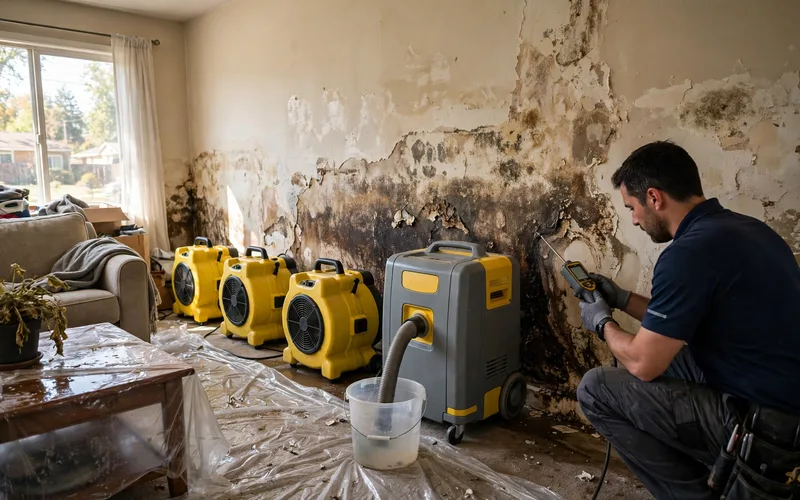
Call (877) 659-0178 for structural drying anywhere in Kelso, WA. After the standing water is extracted, air movers and dehumidifiers dry the structure, and moisture readings track the progress until walls, floors and framing are back to normal moisture levels. Drying is finished when the readings say so, not when the surface looks dry.
Drying time depends on the amount of water, the materials affected and the season. Read how long drying takes, or see the services hub and the Kelso service area page.
Water does not stay where you can see it. Drywall wicks water upward from the floor, subfloor soaks it from below, and framing holds it inside the wall cavity. The surface can feel dry while the inside of the wall is still wet enough to grow mold. That is why drying is measured, not eyeballed: a moisture meter reads the inside of the material, and the job is finished when those readings match a dry standard.
Kelso's climate makes the gap between looking dry and being dry wider than in a dry city. About 48 inches of rain a year and roughly 180 wet days keep indoor humidity high through the wet season, so materials dry slowly on their own. A flooded room left to air-dry in January can stay damp for weeks, and mold can start growing within 24 to 48 hours.
Drywall wicks water upward and holds it inside the wall cavity. Air movers push dry air across the surface and into the cavity until readings show the wall is dry.
Hardwood cups, vinyl lifts and carpet padding soaks water through. Subfloor holds moisture long after the surface dries, and it is checked separately.
Studs, plates and floor joists absorb water and dry slowly. Wet framing is where mold and long-term decay start, so it is verified with readings.
Most Kelso homes stand on crawl spaces, and a high water table keeps them wet for months. Drying one means removing standing water first, then drying the soil, joists and subfloor.
Concrete walls and floors hold water in their pores, and basement drywall and framing soak it up. Drying runs until readings show normal levels.
Cabinets, trim and built-ins trap water behind and beneath them. What can be dried in place is dried; what is saturated beyond saving is removed.
Measure first, dry second, verify last. The readings run the job.
Call (877) 659-0178 and describe the water: where it is, how much there was, and what it touched. Moisture readings map how far the water spread, including into walls and under floors.
Standing water is extracted first, then air movers push dry air across wet surfaces while dehumidifiers pull the moisture out of the air.
Moisture readings are taken through the job and at the end, and drying is finished only when walls, floors and framing read at normal moisture levels.
Drying time is not a fixed number. A small clean-water leak in one room can dry in a few days with professional equipment, while a flooded basement or a saturated crawl space takes longer. The table lists the factors that stretch or shorten a job.
One factor matters more than the rest: when drying starts. Mold can start growing within 24 to 48 hours, so a job that starts the day the water is found is shorter than one that starts a week later.
| Factor | Effect on drying |
|---|---|
| Amount of water | More water means more water to pull out of materials |
| Materials affected | Drywall, hardwood and framing dry at different rates |
| Category of water | Sewage water needs cleaning and disinfection first |
| Season and humidity | Kelso winters are wet, so air-drying alone is slow |
The median Kelso home was built in 1963, about 75 percent of homes predate 1980, and older homes hold more water than newer ones: plaster and lath, thicker framing, and layers of flooring laid over decades. The 1920s and 1940s bungalows around Old Kelso Hill and the mid-century ranches in Butler Acres dry more slowly than the newer homes on the hillsides.
Coverage is Kelso only, across ZIP code 98626, from West Kelso across the Cowlitz River to Lexington at the north end. Drying work peaks in the wet months from October to March, when floods, burst pipes and basement water keep equipment busy.
Drying time depends on the water, the materials and the season. What stretches a job out, and what the readings say at each stage.
How long does drying take?Standing water out fast, then drying started the same visit. Flooding, burst pipes, appliance failures and sewage backups all count as emergencies here.
Emergency water extraction in KelsoRepair after the water is out and the structure is dry: damaged drywall, flooring, trim and cabinets put right. Mitigation stops the damage, repair restores the home.
Water damage repair in KelsoIt depends on the amount of water, the materials affected and the category of water involved. A small clean-water leak in one room can dry in a few days with professional equipment, while a flooded basement or a saturated crawl space takes longer. Drying is finished when moisture readings show the structure is dry.
With a moisture meter, not by touch or by eye. Readings are taken inside the wall and compared with a dry standard for the same material in the same house. When the readings match the dry standard, the wall is dry.
Household fans and open windows help on the surface, but they do not pull moisture out of drywall, subfloor and framing. In Kelso's wet climate, indoor humidity stays high through the wet season, so air-drying alone can leave materials damp for weeks.
Air movers and dehumidifiers run continuously while the structure is drying, because stopping lets moisture settle back into the materials. The equipment is removed once the structure reads at normal moisture levels.
Mold can start growing within 24 to 48 hours on wet drywall, wood and carpet. Over longer periods, wet framing softens, hardwood warps, drywall crumbles and a musty smell sets in that does not leave.
Controlled drying is designed to dry materials without harming them. Some materials cannot be saved once saturated, such as soaked carpet padding and swollen particleboard, and those are removed.
Coverage is Kelso only, across ZIP code 98626, including West Kelso, South Kelso, North Kelso, East Kelso, Lexington, Beacon Hill, Butler Acres, Rose Valley, Aldercrest, Mt. Brynion, Hilltop, Davis Terrace, Old Kelso Hill and Mt. Pleasant.
A wall that looks dry can still be wet inside, and mold grows while it stays wet. Call now, describe the water, and get drying started with readings that prove the structure is dry.
Call (877) 659-0178